Turn customer feedback
into enterprise-grade market research
Kimola analyzes survey responses, support tickets, call center conversations and social discussions the way a research team would.





































 3,000+ teams in more than 90 countries use Kimola.
Every Channel, Including the Ones You Don't Own
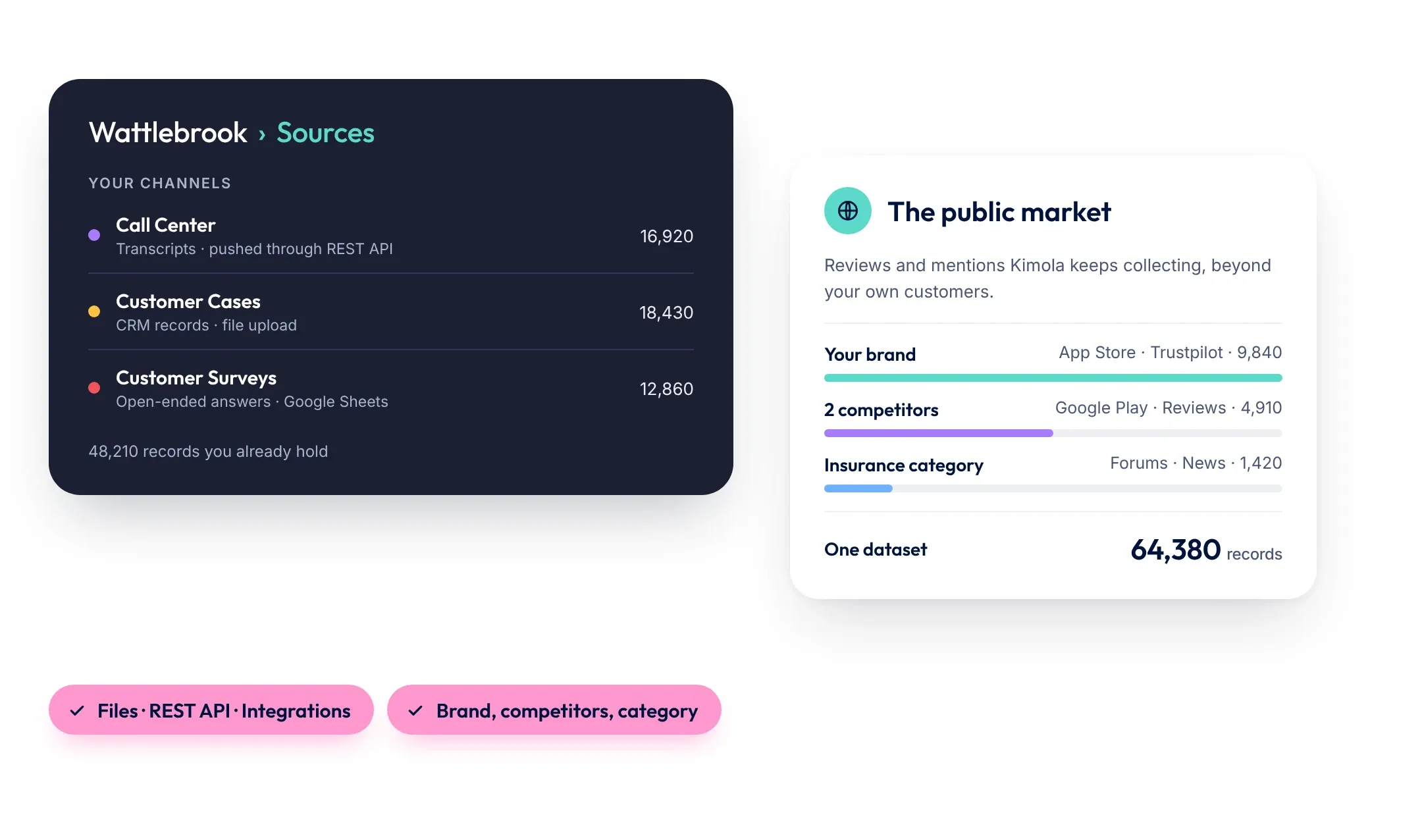
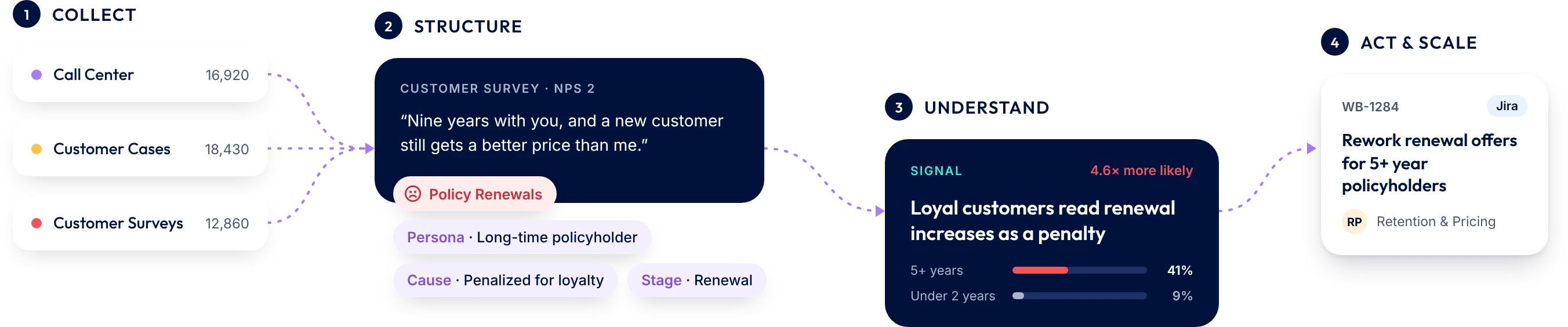
Kimola starts with the feedback your organization already holds: call center transcripts, survey answers, support tickets and CRM records, uploaded as files or pushed through the REST API. Alongside it, Kimola keeps collecting what the market writes in public about your brand, your competitors and your whole category. One platform covers both, so your research reaches beyond your own customers to the market around them.
- Track Reviews
- Track Mentions
- Custom Data Sources
- Scrape Customer Feedback
- Automated Reports & Alerts
Organized the Way a Research Team Would
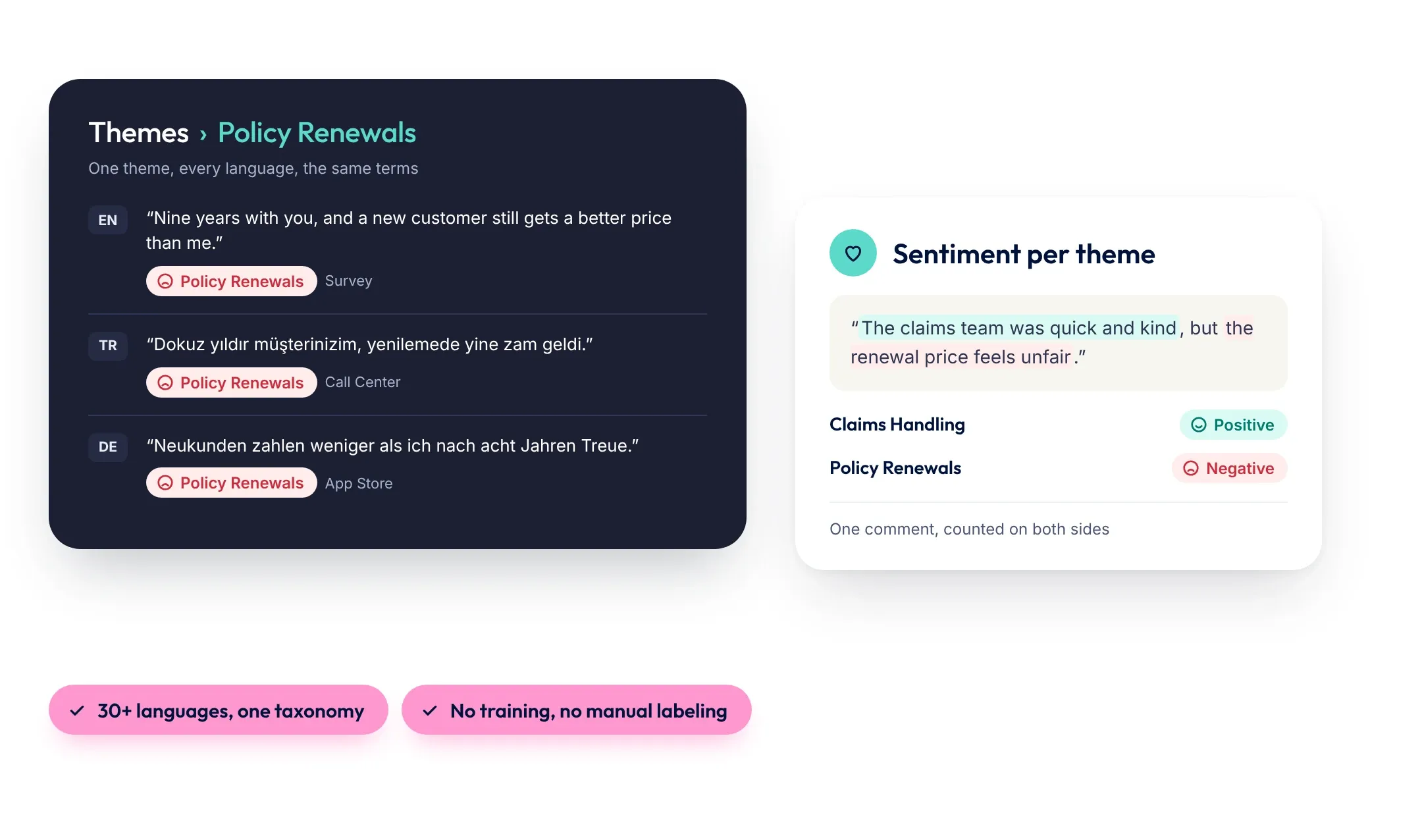
Insight needs a structure people can trust. Kimola builds themes from the context of your data without AI training or manual labeling, scores sentiment for every theme, and applies industry-specific or custom AI models built around your organization's own taxonomy. All of it works in more than 30 languages, in one dataset, so global teams read every market in the same terms.
- Topic & Theme Detection
- Aspect-based Sentiment
- Custom AI Models
- Industry-Specific AI Models
- Analyze in 30+ Languages
Findings Tested Before They Reach a Meeting
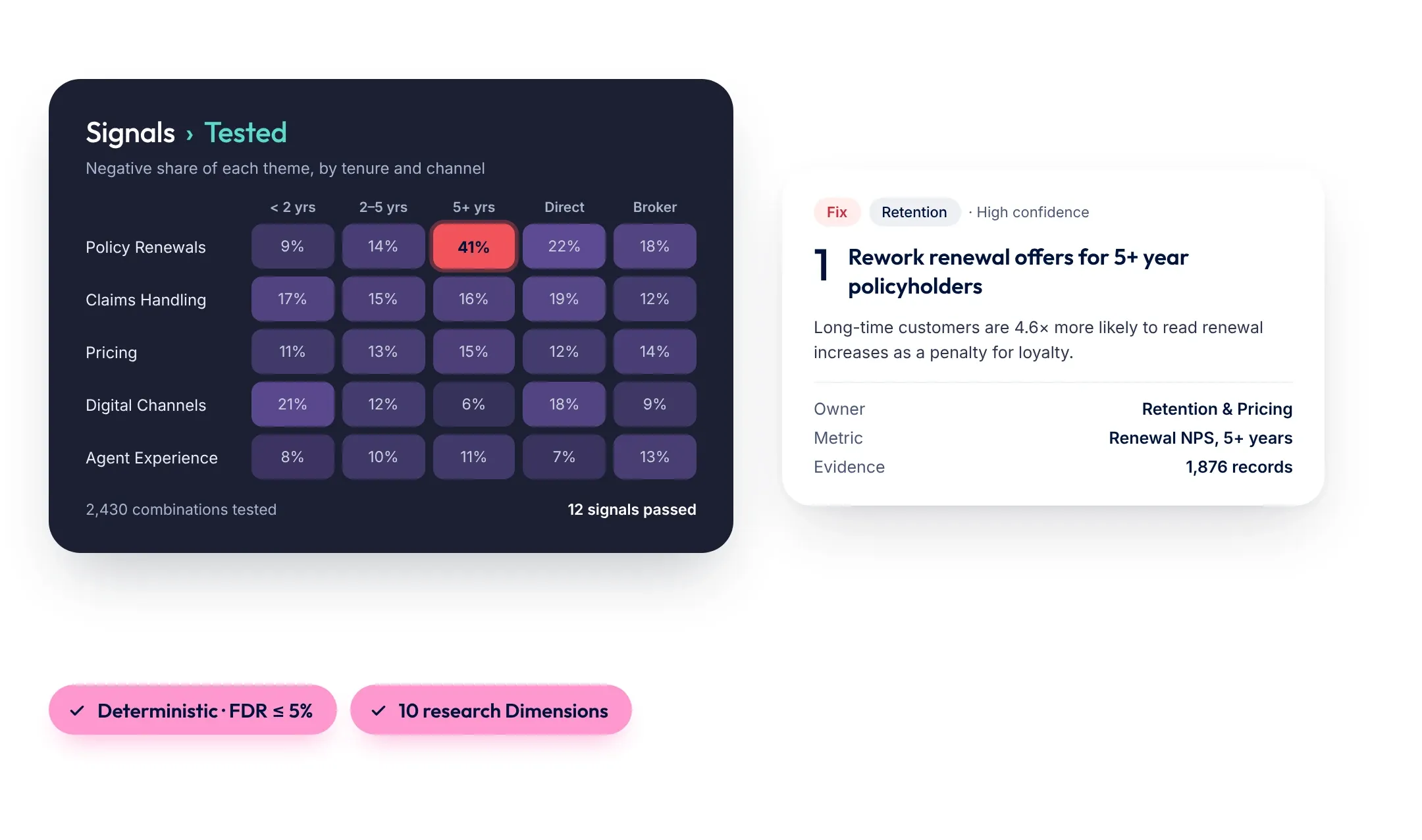
Counting mentions shows what is common. Kimola asks every piece of feedback ten research Dimensions, from motivations and pain points to underlying causes and substitutes, then tests every topic against every segment and period. Signals are deterministic: the same data always gives the same findings, with false discoveries kept at 5% or below. Action Plans turn them into prioritized recommendations, each with an owner, a metric and the evidence behind it.
- Dimensions
- Signals
- Action Plans
- Compare Segments
- Pivot Tables
One Insight Language Across the Organization
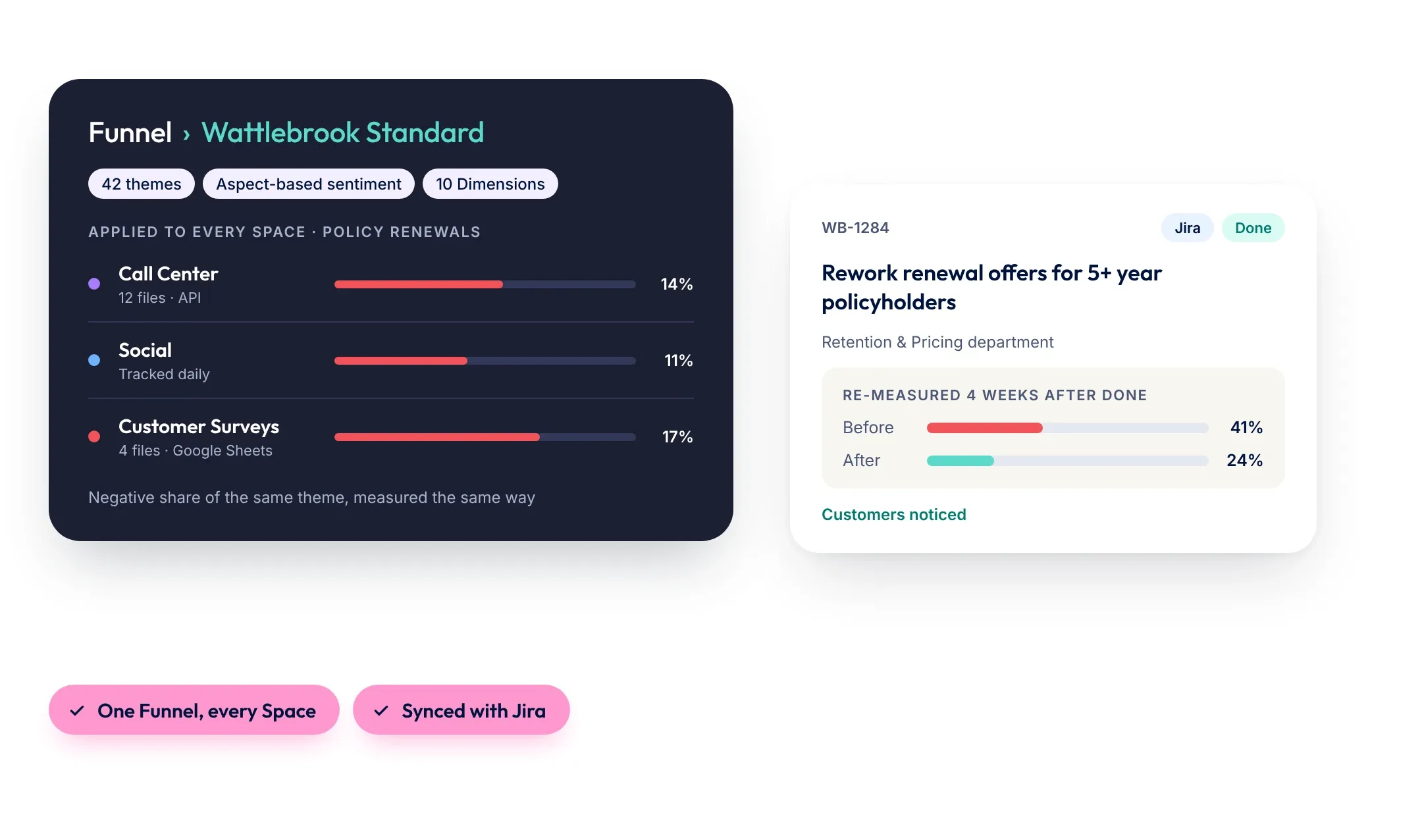
A Report is a standalone study with rules of its own, built for flexible research. An organization needs one standard as well: a Funnel fixes the themes, sentiment and Dimensions once, and every Space applies it to each new file, uploaded or pushed through the API. A theme then means the same thing in the call center and on social media, and everyone measures against the same standard.
Enterprise teams use both, Spaces for the shared standard and Reports for questions that need their own approach. Findings then leave the screen: they become Tasks synced with Jira and re-measured after they close, followed by each Department and down to a single customer.
- Spaces
- Tasks
- Customers
- Departments
- On-premises
See how teams turn different kinds of feedback into research.
-
![Kimola for Product Feedback Analysis]() Product Feedback Analysis
Turn reviews, surveys and support conversations into research on what users need and where they struggle.
-
![Kimola for E-commerce Feedback Analysis]() E-commerce Feedback Analysis
Turn marketplace reviews into market research on why customers buy and where competitors fall short.
-
![Kimola for Social Feedback Analysis]() Social Feedback Analysis
Turn social posts and forum discussions into consumer research on who is talking and how perception shifts.


-
![Kimola for Open-ended Survey Analysis]() Open-ended Survey Analysis
Turn open-ended survey responses into themes, motivations and pain points, compared across every segment.
-
![Kimola for Chat and Call Center Conversation Analysis]() Chat and Call Center Conversation Analysis
Turn chatbot and call center transcripts into research on why customers contact you and what frustrates them.
-
![Kimola for Employee Feedback Analysis]() Employee Feedback Analysis
Turn engagement surveys and exit interviews into workforce research on what motivates people and drives turnover.


Launches, use cases and the thinking behind how we build Kimola.


Frequently Asked Questions
About Kimola
-
What is Kimola?
Kimola is an AI platform that turns customer feedback into enterprise-grade market research. It collects feedback from your own channels and from the public web, structures it into themes, sentiment and research Dimensions, tests what stands out with Signals and turns the findings into Action Plans and Tasks.
-
Is Kimola suitable for enterprises?
Yes. Teams at Miele, Spotify, Lufthansa and Michelin use Kimola. Enterprise teams run their channels in Spaces under one shared Funnel, assign ownership with Departments, follow individual Customers, turn findings into Jira-synced Tasks and connect their systems through the REST API. Kimola can also run on-premises. "Enterprise-grade" describes the research Kimola produces, and every organization gets the same depth.
-
What is the difference between a Report and a Space?
A Report is a standalone study: you upload a file and choose the rules for that analysis, so every Report can take its own approach. A Space follows one channel over time, and every file added to it, by upload or through the API, is classified with the same Funnel. Reports give flexibility, Spaces give the organization a common insight language, and enterprise teams use both. Reports vs. Spaces
-
Can Kimola analyze customer feedback continuously?
Yes. A Space receives new files by upload or through the API and classifies each one as soon as it arrives. Kimola then runs Signals again, so a rising issue surfaces with the latest delivery. Track Reviews and Track Mentions keep collecting public feedback, and automated reports and alerts bring the changes to the right people.
-
Which data sources does Kimola work with?
Kimola works with call center and chat transcripts, survey responses, support tickets, CRM records, employee feedback, public reviews and social conversations. Files arrive as Excel, CSV or TSV, records can be pushed through the API, and Zendesk, Intercom and Google Sheets connect directly. Public reviews and mentions are collected with Track Reviews, Track Mentions and the browser extension.
-
How reliable are Kimola's findings?
Kimola's statistical engines are deterministic: the same data always gives the same Signals, and every test is corrected to keep false discoveries at 5% or below. A language model only writes the text for findings the engines have already decided, so every number comes from the data, and every finding opens the customer feedback behind it.
-
How does Kimola work alongside a CX management platform?
CX management platforms run surveys, route tickets and manage live operations. Kimola is the research layer beside them: it turns the feedback those systems hold, together with public feedback about competitors and the category, into tested findings, root causes and prioritized Action Plans, and closes the loop with Tasks that measure whether customers noticed.
-
Can Kimola be deployed on-premises?
Yes. Kimola On-Premises is the same platform installed in your data center or private cloud, with open-weight language models on your own GPUs and no external AI service. Users sign in through your identity provider with SAML 2.0, OpenID Connect or CAS, roles map from your directory groups, and every action is written to an immutable audit trail.
-
How do organizations start with Kimola?
Any team can create a free account and run research on its own data before speaking to sales, so Kimola is evaluated on real feedback from day one. For organization-wide use, a dedicated Account Manager sets up Spaces, Funnels, Departments and custom AI models around your taxonomy, without months of custom development.
Turn customer feedback into structured market research in 30+ languages—no AI training needed.
Create a Free Account No credit card · No commitment