Astrology Apps Aren't Just for Fun. Users Want Them to Be Accurate.

Ask someone why people download an astrology app and you will probably hear some version of "for fun." A horoscope to glance at over coffee, a compatibility check to send to the group chat, nothing anyone takes too seriously.
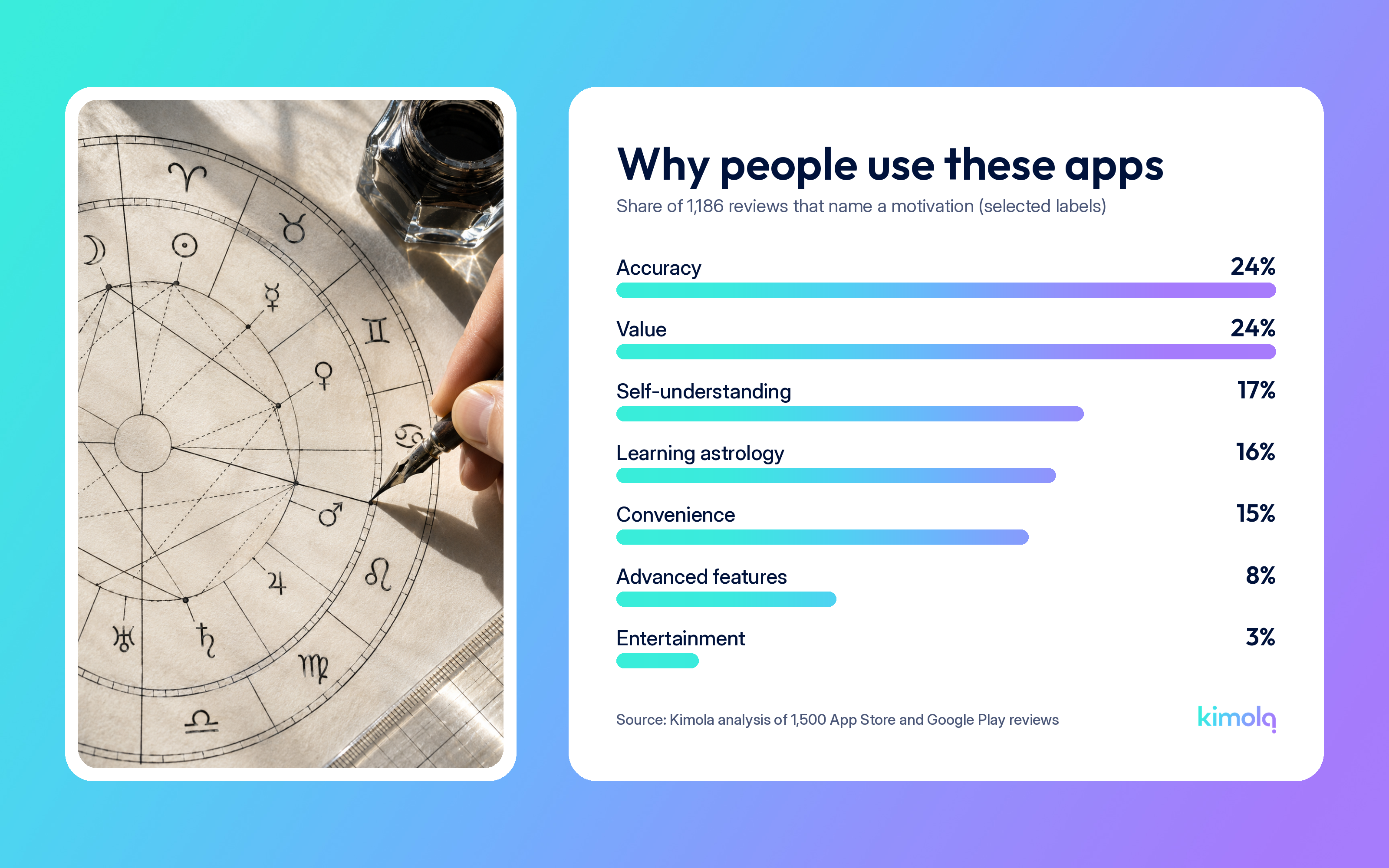
The people who write about these apps in the App Store and Google Play tell a different story. Among the 1,186 reviews that say why someone uses an astrology app, fun barely registers: 3% mention entertainment or casual exploration, while accuracy and value lead at 24% each. People want the app to be right, and they want it to be worth the money. When they complain, the trouble usually traces back to something the app itself changed.
How we did it
Kimola collected the feedback from the App Store and Google Play, scanning reviews published since January 2025 to reach enough material for analysis. The sample favored recent reviews and left out short ones that said too little about the experience. Each app contributed 300 reviews so that none would outweigh the others, for 1,500 in total, dated between January 2025 and November 2026.
The five apps are Co–Star, CHANI, The Pattern, TimePassages and Nebula. They were chosen because their feedback is available on both stores and because together they cover different ways of doing astrology: daily readings, connecting with friends, relationship compatibility, birth chart analysis and live consultations.
Kimola is an AI platform that turns customer feedback into enterprise-grade market research. Kimola found the themes in the feedback without a predefined list, measured the sentiment of each, asked every review a set of research questions, and ran 1,855 statistical tests to find where one app differs from the others.
Accuracy first, fun a distant afterthought
Kimola asks each piece of feedback a set of research questions called Dimensions. One of them, Motivations, asks why the person uses the app; 1,186 of the 1,500 reviews give an answer.
Accuracy and value share the top spot, each named in 24% of those reviews. Self-understanding follows at 17% and learning astrology at 16%. Entertainment and casual exploration sit at 3%, below aesthetics and far below the wish to understand oneself.
So the typical user is checking the horoscope's work. For them, a generic reading is not a harmless miss; it is a product that failed at its job.
Each app gets downloaded for a different reason
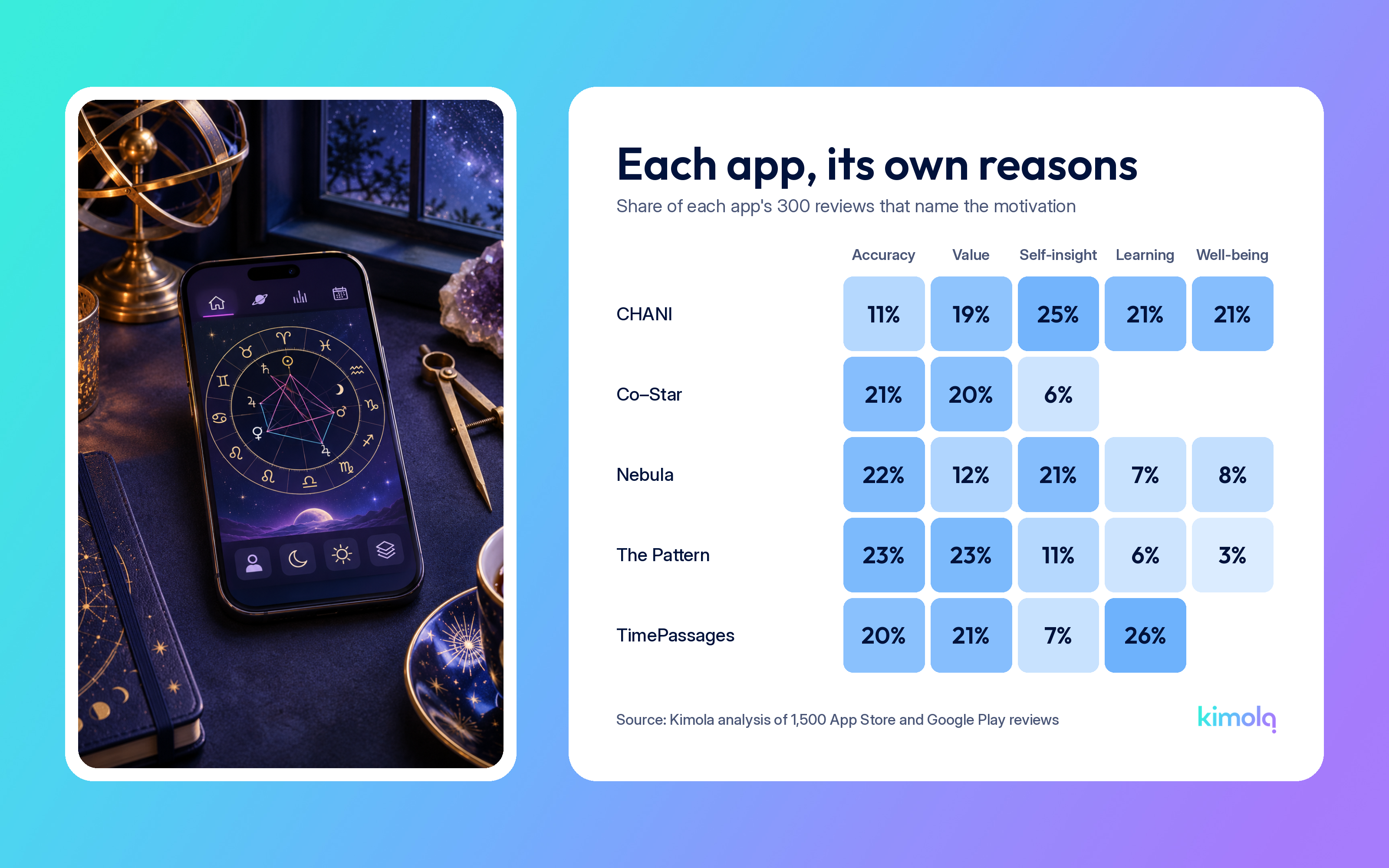
The overall ranking hides five quite different apps. When Kimola crosses each app with its motivations in a table, each one attracts a different kind of user.
TimePassages is where people go to do their homework. Kimola's Signals analysis found that 26% of TimePassages feedback mentions learning astrology, against 12% for the other apps; at Co–Star, the figure is 3%. As one user put it: "This is a app that genuinely wants to teach you about your chart."
CHANI's users come looking inward: 25% of its feedback mentions self-understanding and 21% emotional support. Nebula's users also talk about insight into themselves, at 21% against 11% in the other apps.
Co–Star and The Pattern lean on accuracy and value instead. They are also the two apps whose feedback turns negative most often, which is where the rest of this story goes.
The ones who stay make it a habit
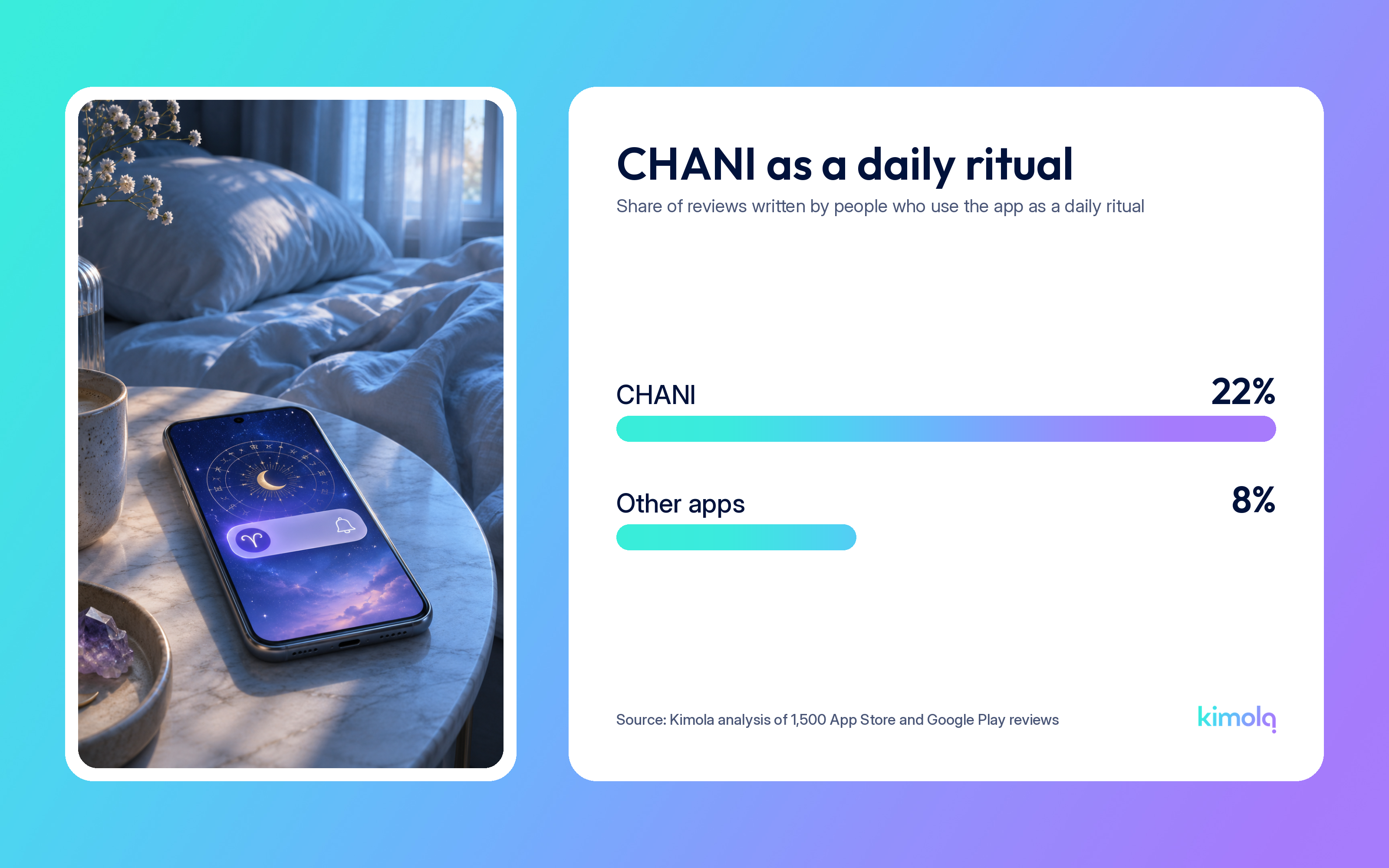
Kimola's Personas Dimension sorts the people behind the feedback into types, and 651 reviews say enough to be placed in one. At CHANI, 22% of feedback comes from people who describe the app as part of their daily routine, against 8% for the other apps, and the gap holds in every comparable group Kimola checked.
One CHANI user explained the habit this way: "It’s the one app I use every day, besides my weather app."
Some of that habit is audio. 8% of CHANI's feedback talks about its podcasts and audio updates, a subject that barely appears for the other apps (0.3%). Hold that thought for the next section.
The ritual is also mostly private. The Social Context Dimension asks who else is involved, and 57% of the 532 reviews that answer describe using the app alone. Friends appear in 8% and romantic partners in 4%.
The inward turn is growing, too. In the second half of 2026, 17% of feedback mentioned self-understanding, compared with 11% in the twelve months before.
What pushes people away is usually an update
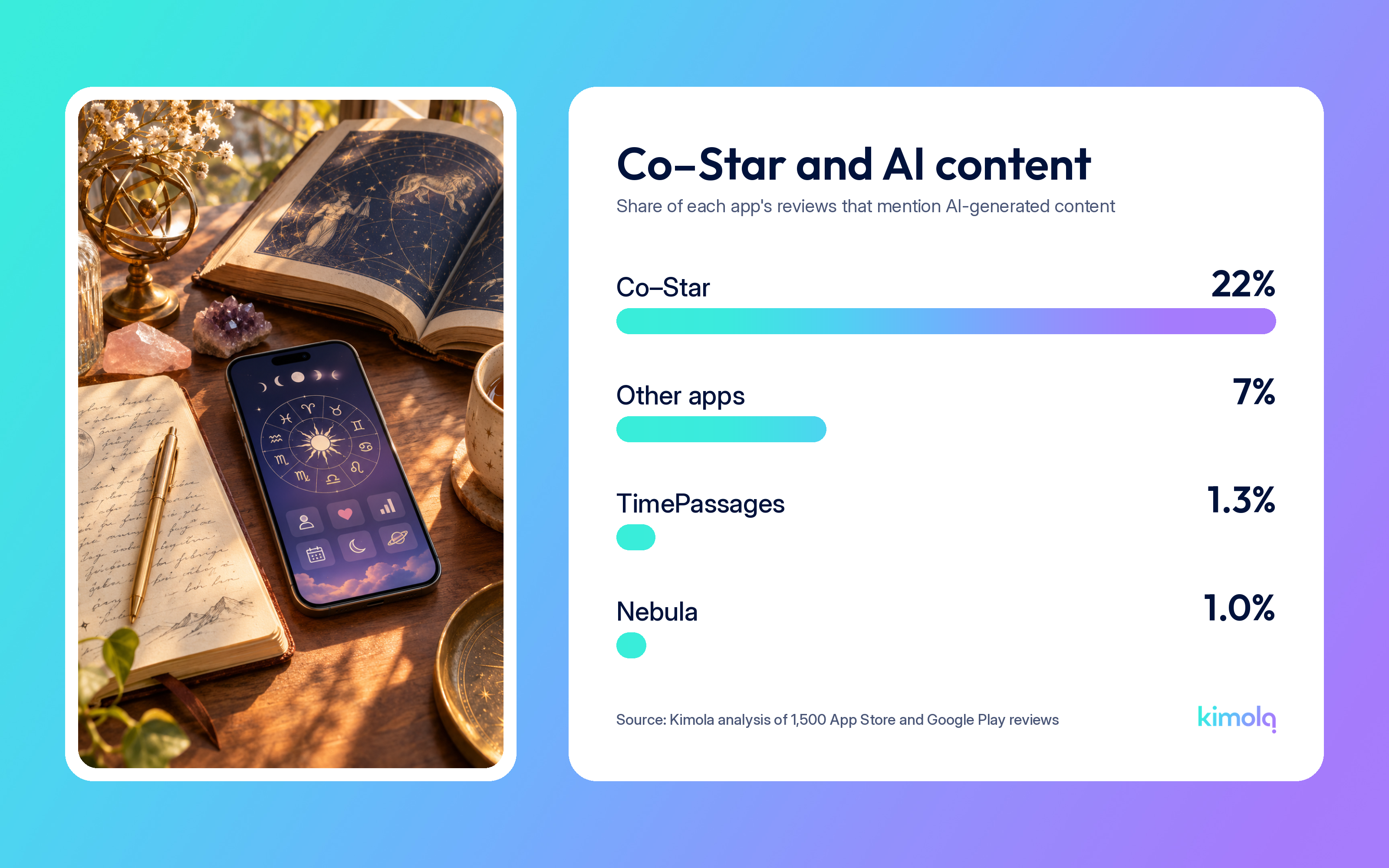
Co–Star's feedback is where the mood turns. 22% of it mentions AI-generated or automated content, against 7% for the other apps; at Nebula and TimePassages the share is 1.0% and 1.3%. The gap holds in every comparable group, and nearly all of these mentions are negative.
Used to LOVE this app, but it's so obvious that the horoscopes are now just ai slop.
The second complaint is nostalgia. 19% of Co–Star's feedback asks for previous features to come back, against 6% elsewhere. The Substitutions Dimension, which asks what the experience is being compared with, points the same way: 332 reviews make such a comparison, and at both Co–Star and The Pattern, 20% of feedback measures the app against an older version of itself.
The Pattern's version of this is about format. 7% of its feedback asks for readable text instead of audio, a request that is practically absent for the other apps. The same audio that CHANI's listeners build their week around is, for some Pattern users, the thing standing between them and their transits.
Sometimes the problem is more literal. 9% of TimePassages feedback raises location and language problems, against 0.9% for the other apps, and the examples Kimola surfaces center on one task: picking a birth location during profile setup. For an app built on birth charts, that is a hard place to get stuck. One user summed up the options: "well I have only one birth location, so uninstalling".
Then there is the bill
Money runs through every app. Paywall And Pricing comes up in 22% of all 1,500 reviews, and Kimola measures the sentiment toward that topic separately from the tone of the whole review: 76% of it is negative.
Who complains depends on who is paying. Among Value-Conscious Free Users, 74% of feedback describes frustration with a paywall. Among Paying Subscribers, the top problem is billing itself, at 42%.
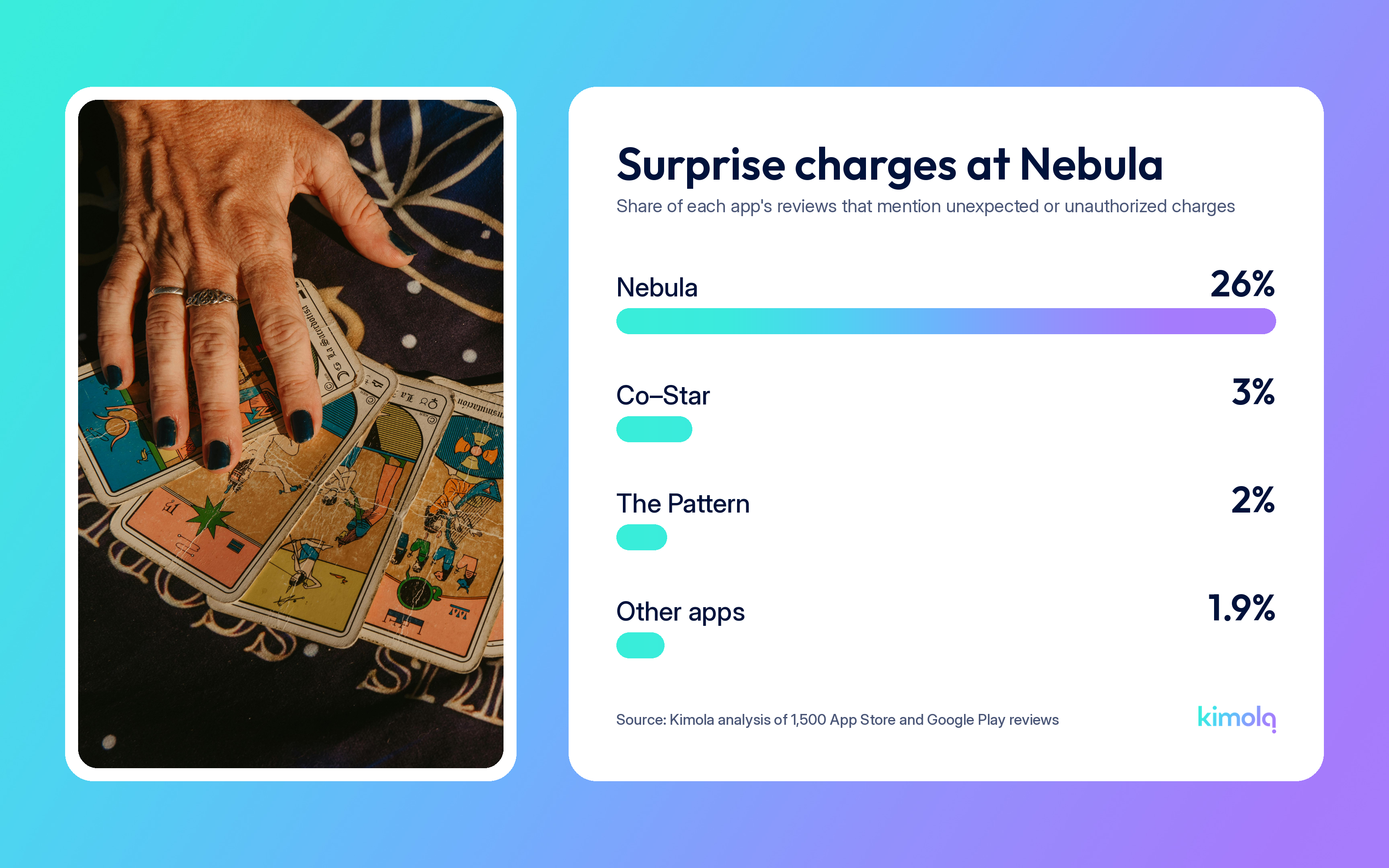
At Nebula, billing becomes the story. 26% of Nebula's feedback mentions unexpected or unauthorized charges, against 1.9% for the other apps, with Co–Star at 3% and The Pattern at 2%. Kimola's consistency check shows the gap varies from group to group, so the exact figure is best read with care; the direction is hard to miss.
Be careful they will charge u without your permission.
It is the same app that, two sections earlier, was helping people understand themselves.
What the stars can't fix
Put together, the feedback describes people who take their astrology app seriously. They come for accuracy, self-knowledge and learning, some of them build it into their day, and the frustrations they write about are mostly about decisions the apps made: AI-written readings, redesigns, audio-only formats and charges. The Underlying Causes Dimension, which asks what lies behind each problem, puts monetization and paywall changes first, at 31% of the 693 reviews that name a cause.
The same questions work for any product people write about: why they came, what keeps them, what they compare you with and what made them leave. If you have app store feedback, survey answers or support conversations of your own, you can run the same analysis in Kimola.