Consumer Segmentation Analysis: Zombie Movies Audience
Ask anyone what zombie fans want and the answer comes quickly: blood, guts and a lot of screaming. The fans themselves describe something else. In 4,175 audience reviews of five recent zombie films, the reason viewers give most often for watching is the story or the idea behind it. A preference for intense or visceral content is named in just 1% of the reviews that give a reason at all.
The second surprise is who walks out happy. Reviewers who write as horror enthusiasts are the most positive group in the study, with 82% of their reviews positive. The harshest are the people who loved the earlier films the most: only 28% of Nostalgic Purist reviews and 18% of Sequel-Skeptic reviews are positive.
How we studied the zombie movie audience
Review platforms don't offer a general "zombie movies" category, so we built the dataset film by film. We picked five zombie and infected-themed films released within the past year, chosen to cover different audiences and different ways people talk about films online: 28 Years Later: The Bone Temple for its large sequel audience, We Bury the Dead for its unusual take on a zombie outbreak, Colony for a Korean view of the genre, Resident Evil for its strong commercial performance, and This Is Not a Test, a lower-rated release, for the expectations of a smaller audience.
The dataset holds 4,175 audience reviews, 3,576 from IMDb and 599 from Rotten Tomatoes, all written over the past year. The films are not equally represented: Resident Evil accounts for 2,133 of the reviews and This Is Not a Test for 128.
The analysis was done in Kimola. Kimola is an AI platform that turns customer feedback into enterprise-grade market research. Here, the feedback is what moviegoers wrote after watching. Kimola read every review through a set of Dimensions, research questions such as who is writing (Personas), why they watched (Motivations) and what let them down (Pain Points). It then ran 2,528 statistical tests to find where one film's audience stands apart from the others.
Who watches zombie movies, and where
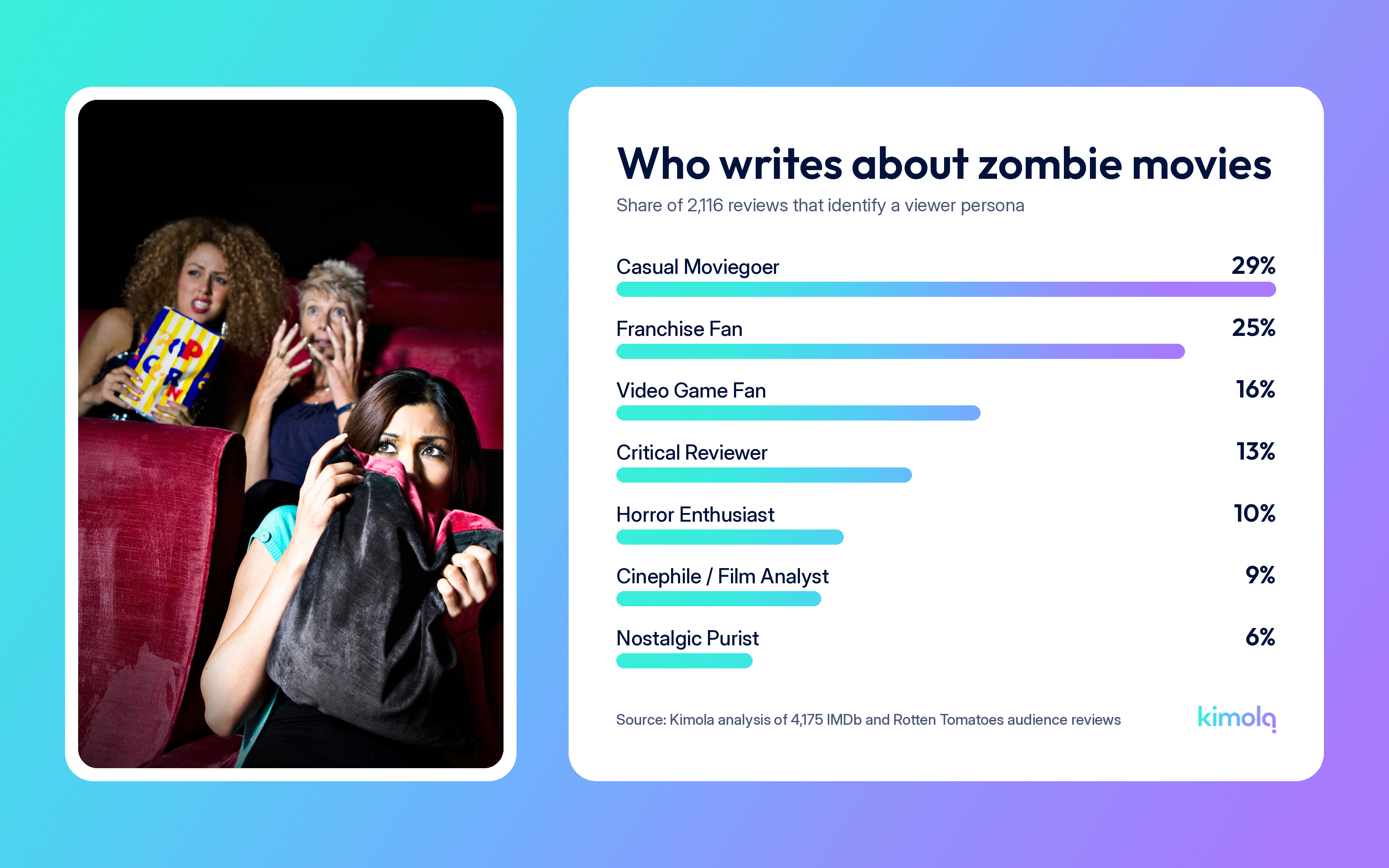
Kimola could identify the role a reviewer writes from in 2,116 reviews. The largest group is the Casual Moviegoer, at 29% of these reviews: people who came for a good night out. Franchise Fans follow at 25%, judging each new film against the ones before it. Video Game Fans make up 16% and Critical Reviewers 13%.
Horror Enthusiasts, the group most people would picture first, account for 10%. Behind them come smaller groups such as Cinephiles and Film Analysts, Nostalgic Purists, Newcomers and Sequel-Skeptics. Several of them matter more than their size suggests, as the rest of this piece shows.
Few reviews say where people watched, but those that do point the same way. Of the 470 reviews that mention a viewing setting, 86% describe watching in a theater and 9% home streaming.
Company is mentioned even less often. Of the 205 reviews that say who was there, the most common answer is the rest of the audience in the room (33%), followed by Friends (23%) and a Romantic Partner (22%). Watching Alone comes up in 11%. Zombie movies, it seems, are still a night out, and preferably not a solitary one.
Story first, gore last
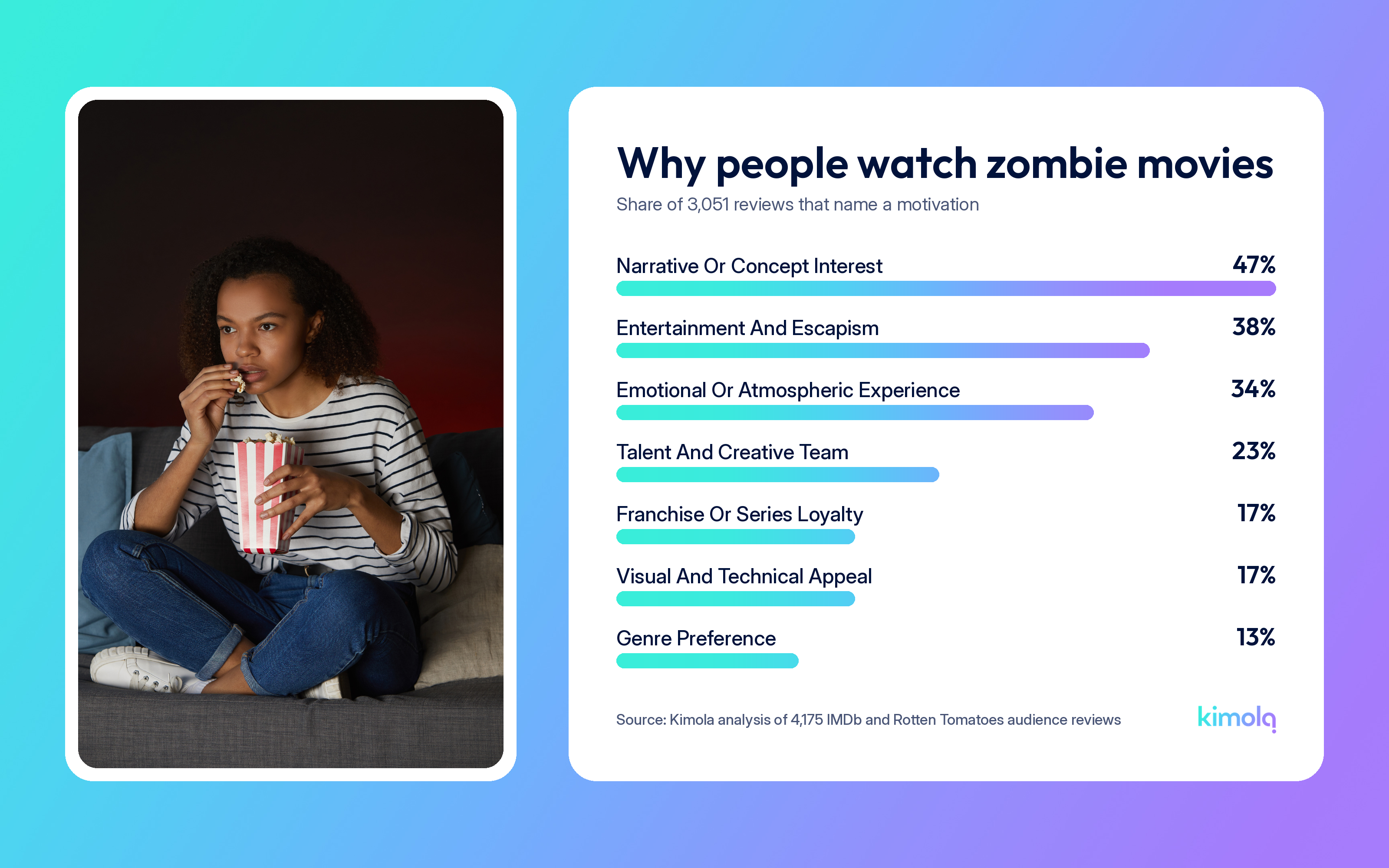
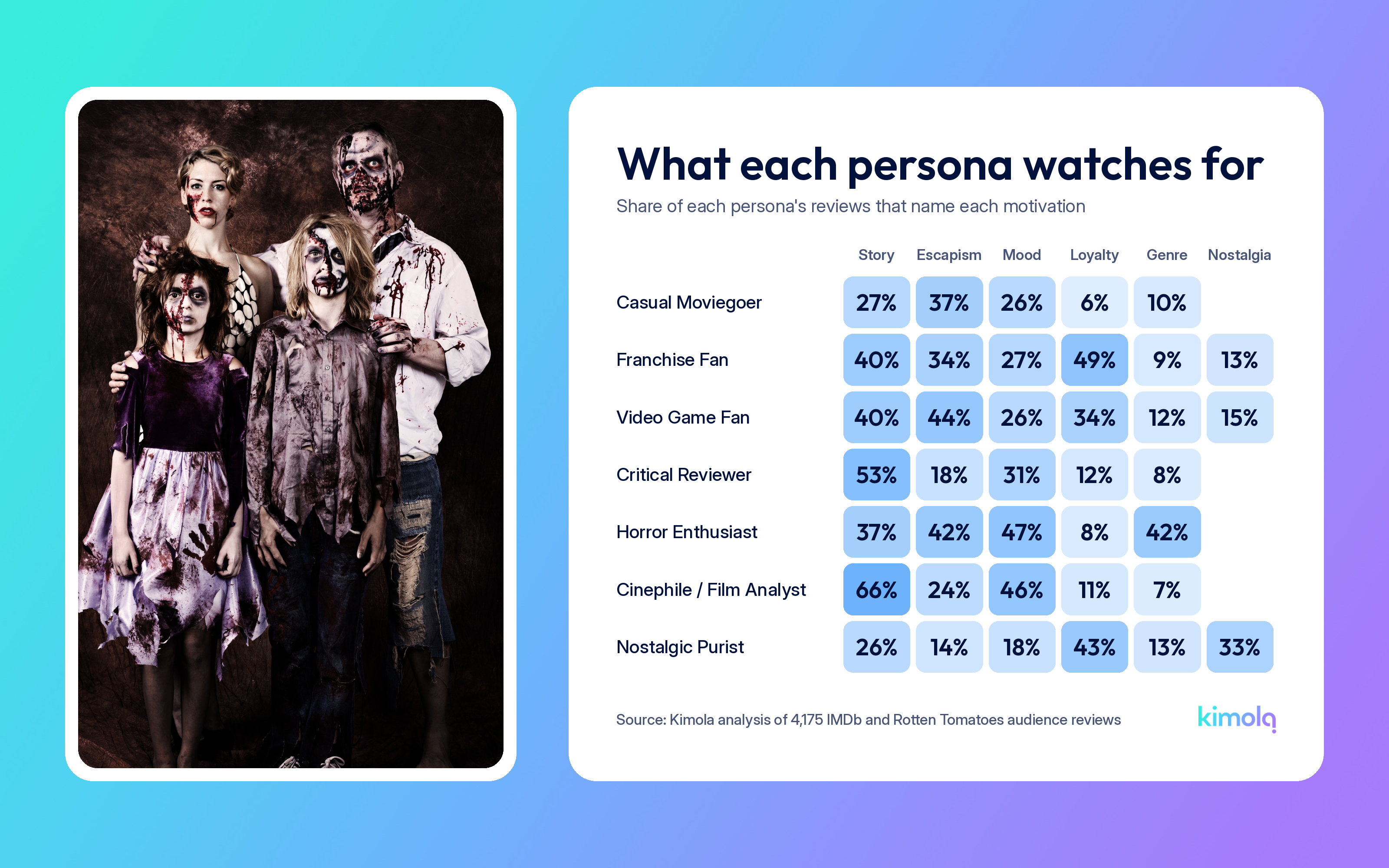
The Motivations Dimension asks why a viewer chose to watch. Of the 3,051 reviews that give a reason, 47% point to interest in the story or concept. Entertainment And Escapism follows at 38%, and an Emotional Or Atmospheric Experience at 34%.
Talent And Creative Team comes next, at 23%. Preference For Intense Or Visceral Content, the motivation most people would guess first, is named in 39 reviews, 1% of those that give a reason. Zombie fans don't object to blood. They just rarely list it as the reason they bought a ticket.
Every persona comes for something different
When Kimola crosses Personas with Motivations, the reasons split mostly the way you would expect. Franchise loyalty drives 49% of Franchise Fan reviews. Casual Moviegoers come mainly for Entertainment And Escapism (37%), and Cinephiles and Film Analysts for the story or concept (66%).
The exception is the horror crowd. Among Horror Enthusiasts, the top reason is an Emotional Or Atmospheric Experience, in 47% of their reviews, with Genre Preference close behind at 42%. A preference for intense or visceral content appears in 4%. Even the viewers who write as horror fans are there for the mood more than the gore.
Nostalgic Purists stand apart in a different way. Their two top reasons are Franchise Or Series Loyalty (43%) and Nostalgia And Familiarity (33%). They come to see something they already love, and that turns out to matter.
The horror fans leave happiest
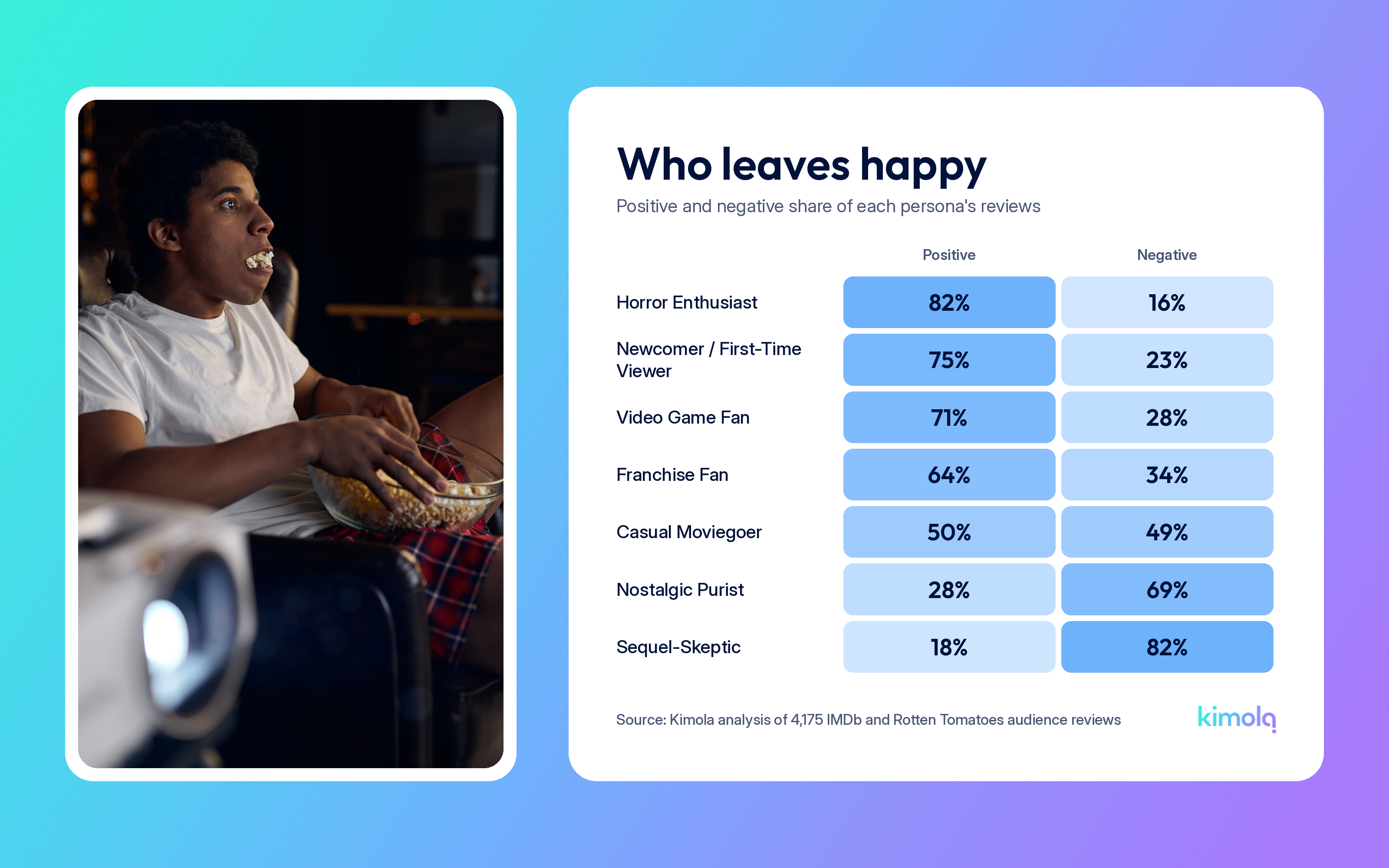
Across all 4,175 reviews, 53% are positive and 44% negative. That average hides a wide spread. Horror Enthusiasts are the most positive group in the study, with 82% of their reviews positive, followed by Newcomers and First-Time Viewers (75%) and Video Game Fans (71%).
Casual Moviegoers split almost exactly in half: 50% of their reviews are positive and 49% negative. If the film was a good night out, it was a good film. If it wasn't, nothing else saved it.
At the bottom are the viewers with the longest memories. Only 28% of Nostalgic Purist reviews are positive, and Sequel-Skeptics are the toughest audience of all, at 18%. Loyalty on its own is not the problem: Franchise Fans share it, and 64% of their reviews are positive. The difference is that purists, as the name suggests, want the franchise to stay as they remember it.
When a film changes the deal
Kimola's Signals show where one film's audience stands apart from the others, and three of the five films have a clear story to tell.
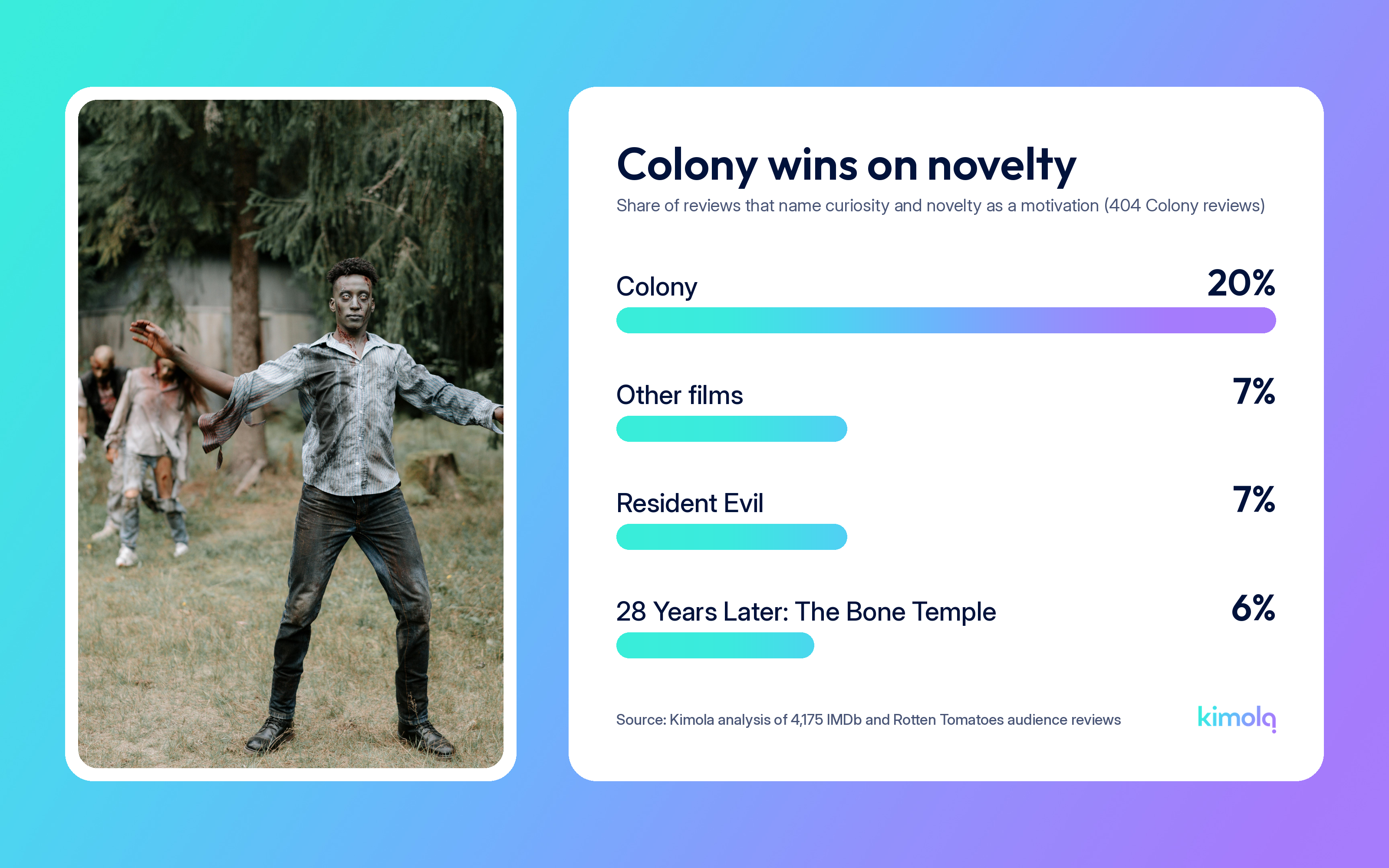
Colony is where novelty pays off. Curiosity And Novelty comes up as a motivation in 20% of Colony reviews, compared to 7% for the other films. These reviews are rarely unhappy: 9% of them are negative, against 33% of all Colony reviews. "Such a creative take on the zombie genre," as one viewer put it.
We Bury the Dead took a bigger swing. 44% of its reviews measure it against the conventional zombie formula, compared to 10% for the other films. Some viewers welcomed the change, describing it as "Not your typical flesh eating zombie movie."
Others ran out of patience. Poor Pacing Or Momentum shows up as a pain point in 35% of We Bury the Dead reviews, compared to 15% for the other films. One reviewer summed it up in four words: "The pace is glacial."
28 Years Later: The Bone Temple tests a different limit. When its reviews discuss gore, violence and shock content, 44% of those comments are negative, compared to 20% for the other films. One viewer who called it an improvement on the first film still added a complaint genre fans will recognize: "Also, very few zombies".
Read next to the motivations, these differences fit the same picture. A new idea is welcome when it serves the story and the atmosphere viewers came for. It meets resistance when it costs them tension, or the zombies.
What this means beyond zombies
The zombie audience is less about gore than its reputation suggests. Viewers come for story and atmosphere, horror fans are the easiest to please, and the hardest to win over are the ones who wanted the old franchise unchanged.
The same questions work for anything people write about on their own: who is talking, why they chose it, and which group a change is likely to lose. If you want to ask them of your own customers' feedback, you can create a Kimola account and start with the data you already have.